
The Science of Early Learning: How Puppy Development Sets the Stage for Therapy Work
- Green Acres K-9 Resort
- Mar 18
- 5 min read

As a helper here at Green Acres Nextgen, I have the absolute best seat in the house. Every day, I get to witness something truly miraculous: the transformation of a tiny, stumbling newborn into a confident, intuitive companion ready to change someone’s life. If you’ve ever met a therapy dog Golden Retriever, you know there is a certain "magic" in their eyes: a calm, steady presence that seems to say, "I’m here for you."
But as much as we’d love to call it magic, the reality is grounded in fascinating neuroscience and dedicated early intervention. At our facility in Boring, Oregon, we don't just raise pets; we cultivate potential. Whether you are looking for Golden Retriever puppies Oregon for your family or a prospect for service work, understanding the science behind those first few months is essential.
The Foundation: Early Neurological Stimulation (ENS)
The journey to becoming a therapy-grade companion starts much earlier than most people realize. In fact, it starts before their eyes even open. From day 3 to day 16 of a puppy's life, we implement a protocol known as Early Neurological Stimulation (ENS), often referred to as the "Bio-Sensor" program.
I remember the first time I watched our team perform these exercises. It’s a series of five specific movements: like holding the puppy upright or touching their paws with a cold cloth: for just 3 to 5 seconds each. It sounds simple, even trivial, but the science behind it is robust. These tiny "stresses" kickstart the puppy’s neurological system.
Research has shown that puppies who undergo ENS exhibit:
Improved cardio-vascular performance (stronger heartbeats).
Stronger adrenal glands.
More tolerance to stress.
Greater resistance to disease.
When we talk about health tested Golden Retriever puppies Oregon, we aren't just talking about hips and elbows (though those are vital!); we are talking about the health of the nervous system. By building a resilient internal "engine," we set the stage for a dog that can handle the busy environment of a hospital or a classroom without becoming overwhelmed.

The Socialization Window: Where Brains Are Built
If you’ve been searching for a Boring Oregon Golden Retriever breeder, you’ve likely heard a lot about socialization. But science tells us this isn't just about "meeting people." Between 3 and 14 weeks of age, a puppy’s brain is like a sponge, characterized by high levels of neuroplasticity. This is the "Socialization Period."
During this time, the puppy's brain is physically forming connections based on their experiences. At NextGen Goldens, we take this window very seriously. We use structured play to introduce our puppies to a "Rule of 7": seven different surfaces, seven different sounds, seven different types of people, and so on.
Why does this matter for therapy work? Because a therapy dog Golden Retriever must be unflappable. When a puppy learns at 6 weeks old that a crinkling plastic bag or a rolling wheelchair isn't a threat, that information is hard-coded into their brain. As I work with these pups in our puppy training sessions, I can see their confidence grow. They learn to look to humans for guidance when they encounter something new, rather than reacting with fear.
Cognitive Stimulation and Problem Solving
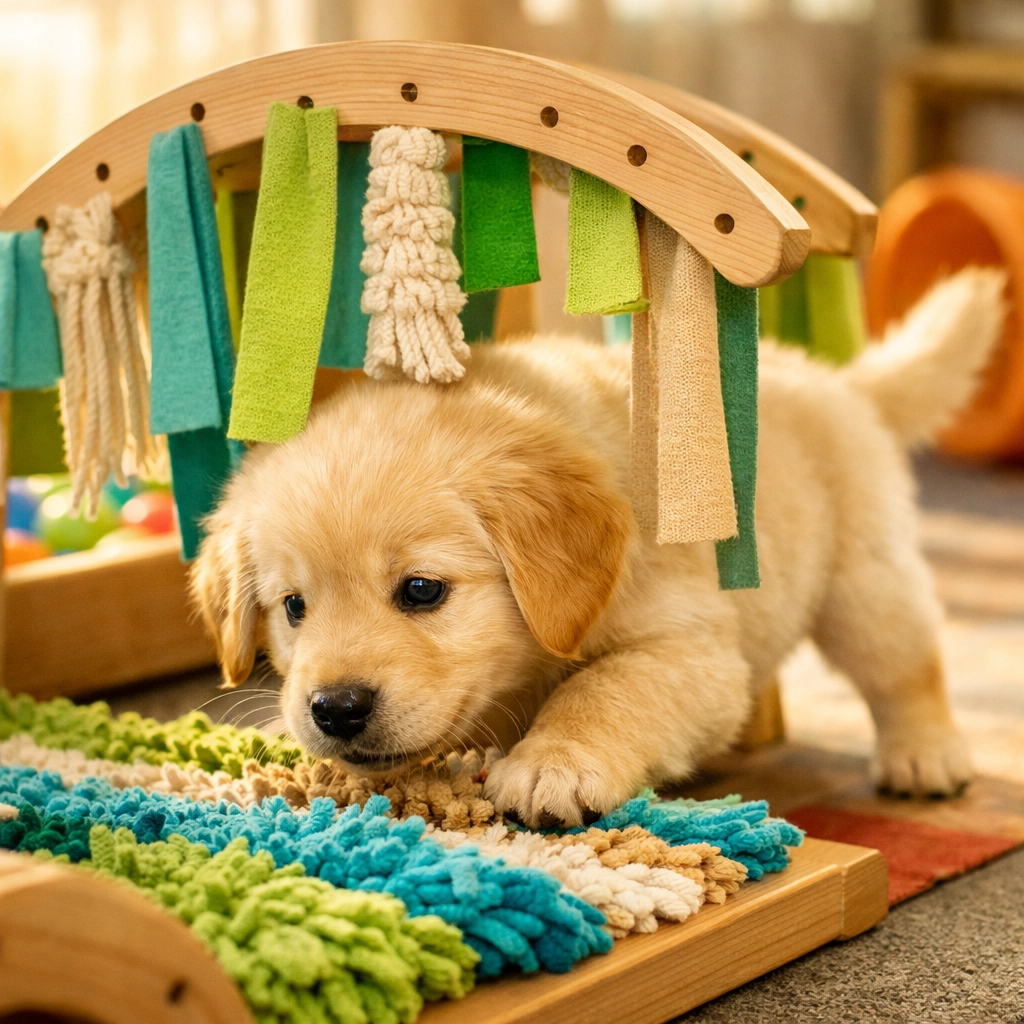
One of my favorite things to do here at Green Acres Nextgen is setting up cognitive puzzles for our litters. You might see a group of 7-week-old Goldens trying to figure out how to get through a low-hanging "car wash" made of pool noodles, or navigating a small bridge.
This is more than just cute: it’s cognitive stimulation. By encouraging puppies to solve small problems, we are increasing the density of their neural pathways. Studies in canine cognition suggest that early enrichment leads to a more developed cerebral cortex.
For a future service dog, this translates to "biddability." A dog that has been taught how to learn as a puppy is much easier to train for complex tasks later in life. This is why choosing a Golden Retriever breeder Oregon who prioritizes brain games is just as important as choosing one who prioritizes physical health.
The Importance of Calm Temperament
While training and environment are crucial, we cannot ignore the role of genetics. To produce calm temperament Golden Retrievers, we start with parents who embody those traits. Our breeding program focuses on "low arousal" lines. This doesn't mean the dogs are lazy; it means they have a high "threshold" before they get stressed or over-excited.
As a Boring Oregon Golden Retriever breeder, we are proud to produce dogs that can flip the switch from a fun game of fetch to a quiet cuddle session. This emotional regulation is the hallmark of a great therapy dog. We ensure all our breeding pairs are health tested Golden Retriever puppies Oregon precursors: meaning the parents have passed rigorous screenings for heart, eyes, hips, and genetic predispositions. You can see our commitment to these standards on our about page.
From Boring, Oregon to the World
Our facility in Boring is designed specifically to facilitate this early learning. From our dog daycare areas that allow for safe social interaction to our quiet "sensory rooms," every square inch of Green Acres Nextgen serves a developmental purpose.
I often tell people that when they take home one of our Golden Retriever puppies Oregon, they aren't just getting a dog; they are getting the result of thousands of hours of scientific application. We want your puppy to be the one that handles a thunderstorm with a nap, or the one that gently rests their head on a crying child’s lap.
If you’re interested in seeing our current litters or learning more about our philosophy, I encourage you to check out our puppies page.
A Journey of Love and Science
Raising a puppy is a thrilling adventure, but raising a great dog is a deliberate act. By focusing on the science of early learning: ENS, cognitive enrichment, and genetic temperament: we ensure that our Goldens are prepared for whatever life throws at them.
Whether they end up working in a local hospital or simply being the heart of your home, the work we do in those first 10 weeks sets the stage for a lifetime of success. It’s a joy beyond compare to see a pup I once held in the palm of my hand grow up to be a steady, loving companion.
If you’re ready to start your journey with a puppy that has had the best possible start, we’d love to hear from you. You can book a consultation or browse our blog for more tips on puppy development and care.
Remember, the "magic" of a Golden Retriever isn't an accident; it's a science.
Bibliography and Scientific Sources
Battaglia, C. L. (2009).Periods of Early Development and the Effects of Stimulation. Journal of Veterinary Behavior. (Focuses on the impact of ENS/Bio-Sensor programs).
Dietz, L. S., et al. (2018).The Importance of Early Socialization in Hand-Raised and Mother-Raised Puppies. Applied Animal Behaviour Science. (Discusses the 3-14 week window and neuroplasticity).
Gácsi, M., et al. (2009).Explaining Dog-Wolf Differences in Utilizing Human Pointers: Is it Genetic or Experiences? Animal Cognition. (Insights into the genetic biddability of specific breeds like Golden Retrievers).
Howell, T. J., et al. (2015).Puppy Parties and Beyond: The Role of Early Age Socialization Practices on Adult Dog Behavior. Veterinary Medicine: Research and Reports.
Scott, J. P., & Fuller, J. L. (1965).Genetics and the Social Behavior of the Dog. University of Chicago Press. (The foundational text for modern puppy developmental stages).