The Science of Socialization: Why the First 12 Weeks Define Your Golden’s Future
- Green Acres K-9 Resort
- Apr 3
- 6 min read
Hey there! I’m Mark Griffin, and when I’m not diving into the intricacies of IT systems here at Green Acres Nextgen, I’m usually found hanging out with our incredible Golden Retrievers. If there is one thing I’ve learned from both the tech world and the dog world, it’s that the "initialization phase" is everything. In IT, a bad setup leads to bugs down the road; in the world of Golden Retriever puppies Oregon, that initialization phase is called socialization.
If you’re reading this, you’re likely either waiting for your new furry best friend or you’ve recently brought one home to the Pacific Northwest. It is such an exciting time! There is truly joy beyond compare in watching a Golden puppy discover the world. But behind those clumsy paws and that sweet puppy breath, there is some serious science happening.
Today, I want to pull back the curtain on why the first 12 weeks of your puppy’s life are the most important weeks they will ever have. It’s not just about "meeting people", it’s about literally building the architecture of their brain.
The 3 to 12-Week Window: The Brain's "Open House"
As a Boring Oregon Golden Retriever breeder, I’ve spent countless hours observing how our litters interact with the world. Science tells us that there is a "critical socialization period" that happens between 3 and 12 weeks of age.
During this time, a puppy’s brain is like a sponge, or, if you’ll humor the IT guy in me, it’s like a fresh hard drive with its write-protection turned off. Their sociability naturally outweighs their fear. This means they are biologically programmed to approach new things with curiosity rather than terror.
The American Veterinary Society of Animal Behavior (AVSAB) notes that this is the primary window of opportunity for puppies to adapt to new people, animals, and environments. If we miss this window, or if the experiences during this time are negative, it becomes significantly harder to "reprogram" those fear responses later in life.

The Neuroscience: Synaptic Pruning and Fear Windows
I find the "why" behind this absolutely fascinating. It all comes down to two major neurological processes: synaptic pruning and the fear window.
1. Synaptic Pruning (The "Use It or Lose It" Rule)
When puppies are born, their brains create an explosion of neural connections (synapses). As they grow, the brain realizes it can’t keep every single connection, it would be too energy-inefficient. So, it starts a process called "pruning."
The connections that are used frequently (like "Hey, that loud vacuum cleaner is actually fine" or "Meeting new kids is awesome!") are strengthened and insulated. The connections that aren't used are "pruned" away. If a puppy isn't exposed to a variety of sounds, textures, and people during those first 12 weeks, the brain literally loses the easy capacity to process those things as "normal."
2. The Fear Window
Right around the 8 to 11-week mark, puppies often go through what we call a "fear imprint" phase. This is a survival mechanism from their wild ancestors. In the wild, a 10-week-old pup needs to start being wary of things that could hurt it.
At NextGen Goldens, we are hyper-aware of this. When you are looking for socialized Golden Retriever puppies, you want a breeder who understands that one bad experience during this "fear window" can have a lasting impact. That’s why we focus on positive, controlled, and low-stress exposure. We want the "sociability" side of the scale to stay tipped firmly down!

Caption: A high-quality photo of a Golden Retriever puppy safely exploring a new environment, like a low-profile agility tunnel or a tactile surface, showing curiosity.
Why This Matters for Your Golden Retriever Temperament
Golden Retrievers are famous for being "everyone’s best friend." But that legendary Golden Retriever temperament isn't just an accident of genetics, it’s nurtured.
Whether you want a calm family companion who can handle a chaotic toddler or a specialized therapy dog who can keep their cool in a hospital setting, early socialization is the key. A well-socialized puppy grows into a dog that can recover quickly from a surprise. If a door slams or a bike zooms past, a socialized dog thinks, "Oh, that was a noise," rather than "The world is ending!"
As you begin this adventure, remember that your goal isn't just to "expose" them to things; it's to ensure they have fun while doing it. As Dr. Ian Dunbar, a pioneer in puppy socialization, famously says, a puppy needs to meet a huge variety of people and have positive experiences before they are even 12 weeks old.
How We Do It at NextGen Goldens in Boring, Oregon
Being a reputable Golden Retriever breeder Oregon families trust means more than just providing a health-tested pup. It means doing the heavy lifting during those first 8 weeks before the puppy even reaches your home.
At our facility in Boring, we use purposeful socialization protocols. This includes:
Tactile Stimulation: Walking on grass, gravel, wood, and tile.
Auditory Exposure: Playing "scary" sounds like thunder, fireworks, and doorbells at low volumes while they eat or play.
Social Variety: Safely introducing them to people of all ages, sizes, and outfits (yes, even hats and umbrellas!).
Early Problem Solving: Using simple puzzles to build confidence.
We want to make sure that when you book online or come to pick up your pup, they are ready to transition into your life with confidence.

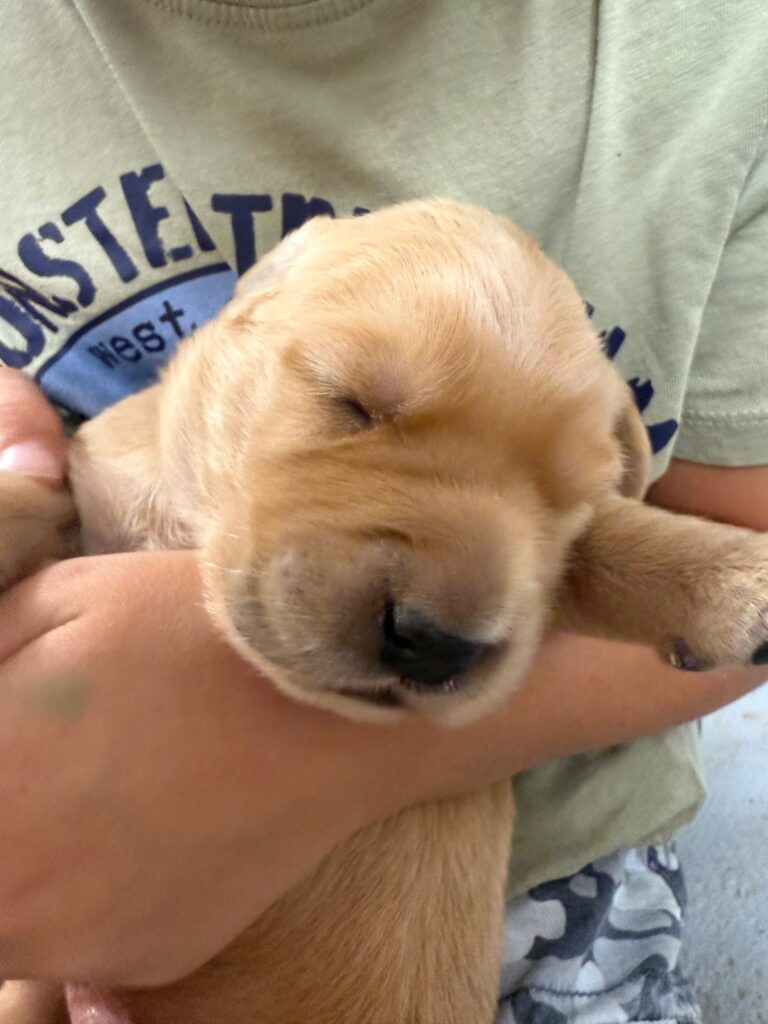
Caption: A warm, inviting photo of a young Golden Retriever puppy interacting gently with a child, highlighting the calm temperament developed through early socialization.
Practical Tips for Your First Month Together
Once you bring your puppy home, you have about four weeks of that "golden window" left (from week 8 to week 12). Here is how you can make the most of it while keeping them safe:
The "Rule of 7s": By the time they are 12 weeks old, they should have met 7 types of people, walked on 7 different surfaces, and played with 7 different types of toys.
Keep it Positive: Always have high-value treats (like small bits of boiled chicken) ready. If they see something new, they get a treat! We want them to associate "new" with "delicious."
Don't Overwhelm Them: Socialization doesn't mean a trip to a crowded pet store on day one. Start small. A neighbor visiting your backyard is a great first step.
Safety First: Consult with your vet about parvo risks in your area. You can socialize your pup in "safe" zones (like your home or a friend's sanitized yard) before they are fully vaccinated.

Caption: A puppy training session showing a Golden Retriever puppy being rewarded with a treat for calmly observing a new object.
A Journey of Love and Growth
I know it can feel like a lot of pressure. You might worry, "Am I doing enough?" or "Did that car backfire ruin my puppy?"
Breathe. This behavior is typical, and your puppy is resilient! The fact that you are even reading about the science of socialization shows you’re going to be an amazing pet parent. Accidents are inevitable, and there will be days when the "fear window" seems to be wide open, but consistency and love win every time.
As you navigate these first 12 weeks, remember that you aren't just raising a dog; you’re building a relationship. Every positive experience is a brick in the foundation of a lifetime of companionship.
If you’re looking for more resources on training or want to see our upcoming litters, check out our Puppy Training page or learn more About Us. We are here to support you every step of the way!
Bibliography & References
To keep our standards high, we always look to the experts. Here are the sources that inform our socialization protocols:
American Veterinary Society of Animal Behavior (AVSAB).Position Statement on Puppy Socialization.AVSAB Website.
Dunbar, Ian. (2004). Before and After Getting Your Puppy: The Positive Approach to Raising a Happy, Healthy, and Well-Behaved Dog. New World Library.
Serpell, J., & Jagoe, J. A. (1995). Early experience and the development of behavior. In The Domestic Dog: Its Evolution, Behaviour and Interactions with People. Cambridge University Press.
Puppy Culture.The Powerful First 12 Weeks.Puppy Culture Program.
Happy socializing, Oregon! Your Golden's future is looking bright.
: Mark Griffin IT Specialist & Golden Lover Green Acres Nextgen