
The Science of Joint Health: Protecting Your Golden Retriever Puppy’s Future
- Green Acres K-9 Resort
- Feb 28
- 5 min read

There’s nothing quite like the feeling of bringing home one of our Golden Retriever puppies in Oregon. Those floppy ears, the wagging tail that never stops, and that unmistakable puppy breath: it’s a joyful adventure from day one! As a helper here at Green Acres Nextgen (most of you know us as NextGen Goldens), I get the privilege of watching these little guys grow from their very first steps. But behind all those cute clumsy tumbles lies a complex biological process that determines how well your dog will move ten years from now.
When you’re looking for health tested Golden Retriever puppies in Oregon, you’re already making a smart choice. You want a dog that can hike the Cascades with you or play fetch at the coast for years to come. To make that happen, we need to talk about the science of joint health. It might sound a bit technical, but I promise it’s the most important thing you’ll learn as a new puppy parent!
The Blueprint: It Starts with Genetics
I like to think of a puppy’s health like building a house. You can have the best construction crew in the world, but if the blueprint is flawed, the house won't stand the test of time. In the world of Golden Retrievers, that blueprint is their DNA.
Golden Retrievers are historically predisposed to certain skeletal issues, specifically hip and elbow dysplasia. These are conditions where the joint doesn't fit together perfectly, leading to friction, wear-and-tear, and eventually, painful arthritis. This is why being an ethical Golden Retriever breeder in Oregon means more than just having "cute dogs." It means rigorous science.
At NextGen Goldens, we utilize OFA (Orthopedic Foundation for Animals) testing and comprehensive genetic screening for all our breeding pairs. Before a mom or dad dog is ever cleared to have a litter, their hips and elbows are X-rayed and evaluated by specialists. We only breed dogs with "Fair," "Good," or "Excellent" ratings. By ensuring our breeding pairs have the best possible skeletal foundations, we are giving your puppy the best possible "blueprint" for a healthy life.

The Mystery of the Growth Plate
If genetics are the blueprint, the growth plates are the construction site. This is a topic I’m really passionate about because it’s something many new owners haven't heard of.
A puppy’s bones aren't solid yet. At the ends of their long bones are areas of soft, developing cartilage called growth plates. These plates are responsible for the bone growing in length and shaping the joints. In Golden Retrievers, these plates don't fully "close" or calcify into solid bone until they are somewhere between 12 and 18 months old.
Because these areas are soft, they are incredibly vulnerable. If a puppy suffers a trauma to a growth plate: like a hard fall or too much repetitive stress: the bone might grow unevenly or stop growing altogether. This is often how "elbow dysplasia" or "hip dysplasia" starts, even in dogs with good genetics. As your OFA tested Golden Retriever breeders, we provide the foundation, but the first year of your puppy's life is where the "construction" is finalized.
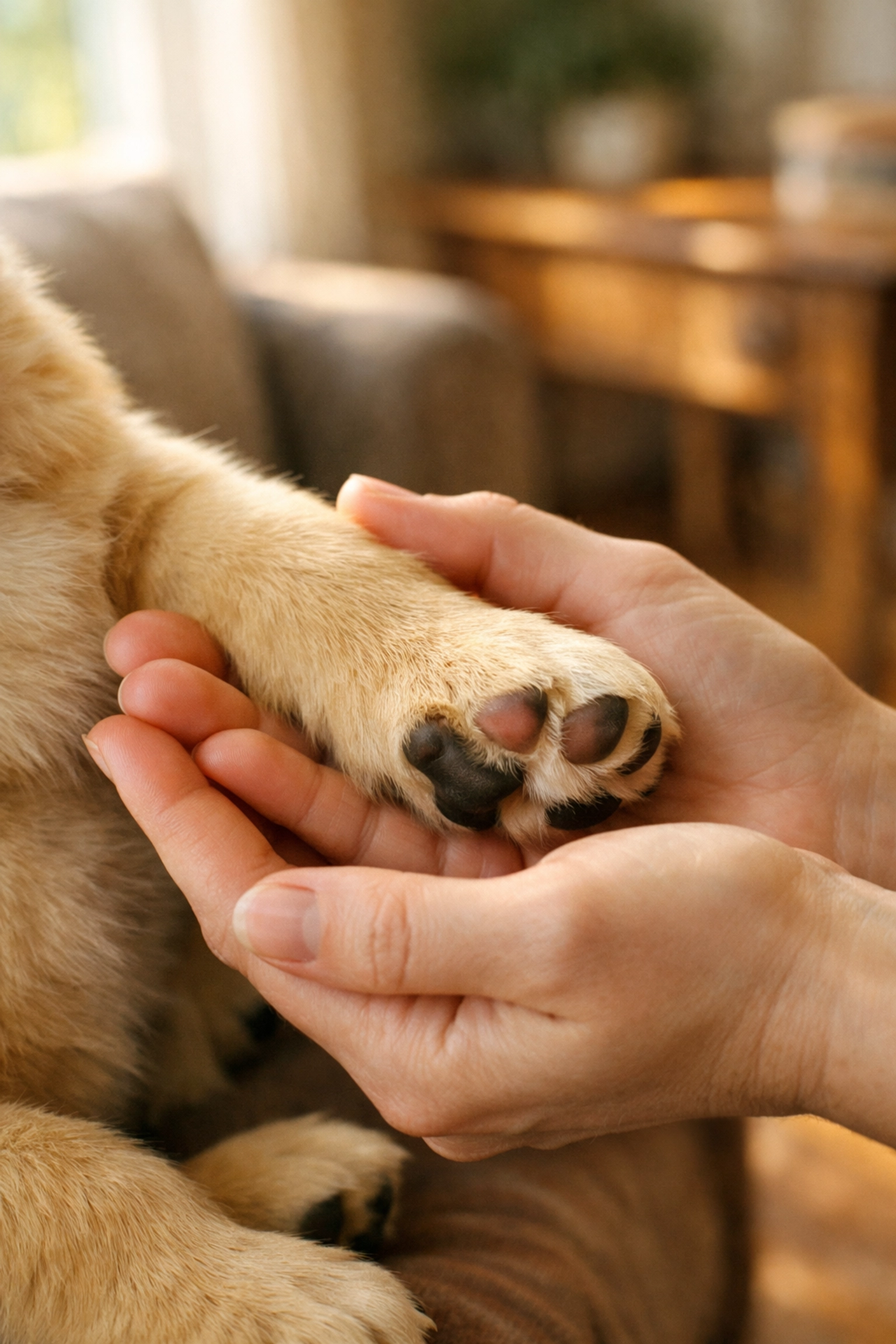
Instruction: A diagram or a visual representation showing where growth plates are located in a puppy's leg joints to help owners visualize the "soft" areas.
Nutrition: Building Blocks and the Calcium/Phosphorus Ratio
I often tell our families that what you put in the bowl is just as important as the walks you take. When it comes to joint health, the biggest mistake people make is trying to make their puppy grow too fast. We all love a big, chunky Golden, but rapid growth is the enemy of healthy joints.
The science shows that the ratio of calcium to phosphorus in a puppy’s diet is critical. If a puppy gets too much calcium, their bones can grow too quickly and become less dense, or they can develop "osteochondrosis," where the cartilage doesn't properly attach to the bone.
This is why we always recommend a high-quality "Large Breed Puppy" formula. These foods are scientifically designed to have a slightly lower calorie count and a strictly balanced mineral ratio to ensure your puppy grows at a slow, steady, and healthy pace. If you’re looking for the right gear to start your journey, feel free to check out our supplies category for recommendations we trust.
The 5-Minute Rule: Proper Exercise
As a proud new pet parent, I know how tempting it is to take your new best friend on a five-mile hike through the Oregon woods. But remember those soft growth plates? High-impact exercise is a major risk factor for joint disease.
We follow a general guideline called the "5-Minute Rule." This suggests that a puppy should have 5 minutes of formal, structured exercise (like walking on a leash) for every month of their age, up to twice a day.
3 months old: 15 minutes twice a day.
6 months old: 30 minutes twice a day.
Free play in the yard is great because puppies can stop when they’re tired. But forced exercise: like running on pavement or jumping for frisbees: should be avoided until their joints are fully mature. If you're looking for ways to burn off that puppy energy without hurting their joints, our puppy training services focus on mental stimulation, which tires them out just as much as a long run!

Instruction: A happy Golden Retriever puppy playfully trotting on grass, showing off its natural athleticism and strong structure.
Environmental Factors: The "Slippery" Danger
I found that one of the most overlooked risks to joint health is actually inside your home! If you have hardwood or tile floors, your puppy is basically living on a skating rink. Every time their legs slide out from under them (the "Bambi" effect), it puts immense strain on the ligaments and the developing hip sockets.
Adding area rugs or runners in high-traffic areas during that first year can significantly reduce the risk of micro-tears in the joint tissue. It’s a simple fix that makes a world of difference for their long-term mobility.
Why We Do What We Do
At NextGen Goldens, our mission as an ethical Golden Retriever breeder in Oregon is to ensure that the puppy you take home is prepared for a long, pain-free life. We invest heavily in the "blueprint" through OFA testing and genetic screening so that you can focus on the "construction": the love, the training, and the proper care.
Seeing our pups grow into strong, athletic adults is why we do this. Whether they are going on to be service dogs, hunting companions, or just the world's best couch snugglers, their foundation matters. If you're ready to start your journey with a new family member, you can see our available puppies here.
Summary Checklist for Joint Health:
Choose the right breeder: Ensure they are health tested Golden Retriever puppies Oregon experts who use OFA screening.
Watch the weight: Keep your puppy lean. You should be able to feel their ribs easily.
Control the growth: Use large-breed specific puppy food to manage calcium levels.
Limit impact: No long runs or high jumping until at least 12-18 months of age.
Add traction: Use rugs on slippery floors to prevent "splay-legging."
Protecting your Golden Retriever’s future is a team effort. We provide the genetics, and you provide the environment. Together, we can make sure your pup stays active and happy for a lifetime!
Scientific Bibliography & References
Orthopedic Foundation for Animals (OFA). (2024). Hereditary and Environmental Factors in Canine Hip Dysplasia. [ofa.org]
Larsen, J. A. (2017). Feeding Large Breed Puppies. Veterinary Clinics: Small Animal Practice, 40(4), 723-739.
Smith, G. K., et al. (2006). Evaluation of risk factors for degenerative joint disease associated with hip dysplasia in German Shepherd Dogs, Golden Retrievers, Labrador Retrievers, and Rottweilers. Journal of the American Veterinary Medical Association, 219(12), 1719-1724.
Krontveit, R. I., et al. (2012). Housing- and exercise-related risk factors associated with the development of hip dysplasia as determined by radiographic evaluation in a prospective cohort of four large dog breeds. American Journal of Veterinary Research, 73(6), 838-846.
UC Davis Veterinary Medicine. (2020). Assessing the effects of neutering on joint disorders and cancers in Golden Retrievers. PLOS ONE.