
The Science of Intuition: Why Golden Retrievers Excel as Therapy Dogs
- Green Acres K-9 Resort
- Mar 2
- 6 min read

If you’ve ever sat on the floor after a long, grueling day and had a Golden Retriever gently rest their chin on your knee, you know it feels like more than just a coincidence. It feels like they know. As a helper here at Green Acres Nextgen, I’ve had the privilege of watching this "sixth sense" in action hundreds of times. Whether it's a puppy sensing a child's hesitation or an adult dog leaning into a person who is grieving, there is a profound, almost psychic connection at play.
But here is the exciting part: it isn't just magic. It’s science.
When we talk about emotional support Golden Retrievers, we are looking at a perfect storm of evolutionary history, specific biological markers, and intentional breeding. Today, I want to pull back the curtain on why our beloved Goldens: especially those we raise here at NextGen Goldens: are uniquely wired to be the ultimate therapy companions.
The Heart of the Matter: Emotional Contagion
Have you ever noticed that when you’re stressed, your dog seems restless? Or when you’re laughing, they’re suddenly bouncing around with joy? This isn't your imagination. It’s a phenomenon called "emotional contagion."
Scientific research has shown that dogs are among the few species capable of mirroring the emotional states of humans. This goes beyond just reacting to a command; it’s a primitive form of empathy. When you feel a surge of cortisol (the stress hormone), your body language changes, your scent shifts, and your tone of voice hits different frequencies. Golden Retrievers are masters at picking up these micro-signals.
In the world of therapy work, this is a superpower. A dog that can "catch" your calm or identify your distress can intervene before a panic attack full-blooms or provide a grounding presence during a difficult therapy session. At NextGen Goldens, we see this daily. Our dogs don’t just sit by you; they tune into you.

A gentle English Cream Golden Retriever resting its head calmly on a person's lap, capturing a moment of quiet connection and support.
The NextGen Difference: Breeding for Lower Cortisol
You might wonder why some dogs are naturally "chill" while others are "wired." While environment plays a role, the foundation is written in their DNA. This is where our work as therapy dog breeders in Oregon becomes truly specialized.
Traditional breeding often focuses purely on aesthetics or hunting ability. However, at NextGen Goldens, we prioritize "NextGen" traits: lower baseline cortisol levels and high sociability.
Lower Cortisol: Puppies born to mothers with lower stress levels often inherit a more resilient nervous system. By selecting parents with exceptionally calm temperament Golden Retrievers, we ensure the puppies are less likely to overreact to loud noises or strange environments: a must for therapy work in hospitals or schools.
High Sociability: There is a genetic component to how much a dog seeks out human interaction. Our breeding program emphasizes dogs that aren't just "compliant," but are "pro-social." They genuinely find joy in human touch and proximity.
When you start with a NextGen Golden, you’re starting with a biological head start toward empathy.
The Oxytocin Loop: A Two-Way Street of Healing
One of the most beautiful aspects of interacting with a Golden Retriever is the physiological change that happens in your body. When you pet a dog, especially one as soft and gentle as an English Cream, your brain releases oxytocin: often called the "love hormone" or "cuddle chemical."
Oxytocin lowers your heart rate and reduces blood pressure. But here’s the kicker: research shows the dog’s oxytocin levels rise too! It is a self-reinforcing loop of bonding and relaxation. This is why Golden Retrievers are the gold standard for emotional support Golden Retrievers. They don't just endure the petting; they thrive on it, which in turn makes the human feel even more supported.
As you begin this adventure of looking for a companion, it’s worth noting that this bond is strongest with breeds that have been historically selected for "soft" temperaments. The Golden Retriever was originally bred to have a "soft mouth" to retrieve game without damaging it. That physical gentleness has evolved over decades into an emotional gentleness.
Why Oregon is the Hub for Therapy Goldens
If you are looking for Golden Retriever puppies in Oregon, you are in a unique position. The Pacific Northwest has a rich culture of service and therapy dog work, and our community here at Green Acres Nextgen is at the heart of it.
I often tell folks who visit us that choosing a puppy isn't just about picking the cutest face (though, let’s be honest, they’re all adorable!). It’s about finding that specific soul that matches your needs. Whether you need a dog for a formal hospital setting or a companion to help navigate anxiety at home, the "intuitive" nature of a well-bred Golden is your greatest asset.

Training the Intuition
While the "hardware" (genetics) is vital, the "software" (training) is what brings it all together. Even the most intuitive dog needs to learn how to channel that empathy.
For instance, a dog might sense you’re sad and try to help by jumping on you. In a therapy setting, we want that dog to lean in quietly instead. This is why we recommend starting with a solid foundation. If you're looking for guidance, our Basic Training Guide is a fantastic place to start.
We also offer specific companion puppies that have been evaluated for their potential in therapy and emotional support roles. Seeing these dogs move from our home in Oregon to lives of service across the country is the most rewarding part of my job.

A Golden Retriever puppy sitting patiently during a social socialization exercise, showing early signs of a calm and focused temperament.
Real Stories: The Impact of a Calm Presence
I remember a family who came to us a few years back. They were looking for a dog for their daughter, who struggled with sensory processing issues. They needed a dog that wouldn't just be a pet, but a stabilizer.
They chose a puppy with a particularly low-arousal temperament: what we call a "soul-gazer." A few months later, they sent us a video. The daughter was having a meltdown, and the dog didn't bark or run away. He simply walked over and laid his entire body weight across her lap: a technique known as Deep Pressure Therapy. He knew exactly what she needed without a single word being spoken.
That is the science of intuition in action. That is why we do what we do at NextGen Goldens.
Is a Golden Retriever Right for You?
If you are looking for a dog that can read the room, offer a steady paw, and lower the "emotional temperature" of your home, a Golden is hard to beat. Their evolutionary journey from the field to the fireside has prepared them perfectly for the stresses of our modern world.
If you’re ready to learn more about our current litters or the philosophy behind our breeding, I encourage you to check out our About Us page or browse our available puppies. We are here to help you find that perfect, intuitive match.
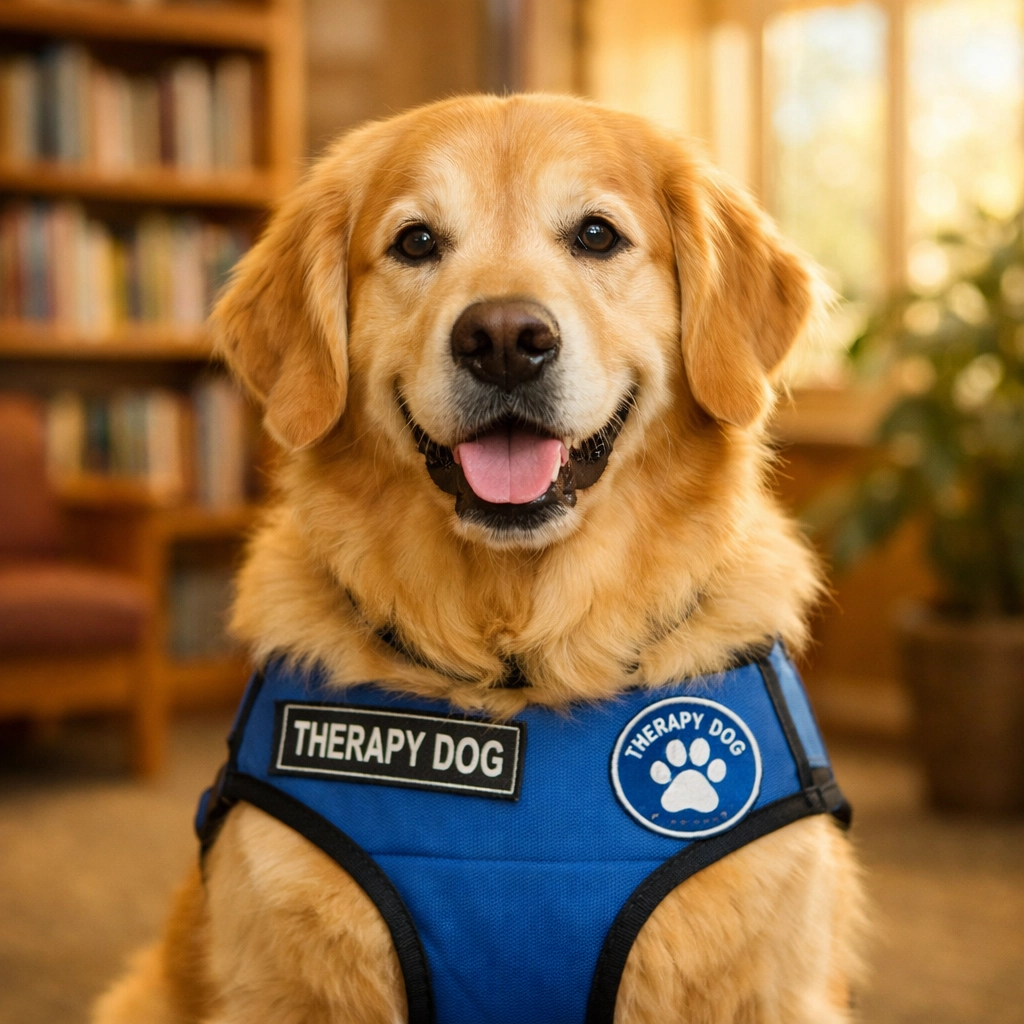
An adult Golden Retriever wearing a therapy dog vest, sitting calmly in a bright, welcoming room, ready to provide support.
Conclusion
The connection we share with dogs is one of the most pure things left in this world. Understanding the science behind it: the oxytocin, the cortisol, the emotional contagion: doesn't take away the magic. If anything, it makes it more incredible. It shows that these dogs were, in many ways, designed to love us.
As you look for your next four-legged family member, remember that you aren't just getting a pet; you're gaining a partner who is biologically tuned to your well-being. And that, my friends, is a truly thrilling adventure.
Scientific Bibliography & References
Custance, D., & Mayer, J. (2012).Empathic-like responding by domestic dogs (Canis familiaris) to distressed humans: an exploratory study. Animal Cognition. (Explores the biological basis for emotional contagion).
Nagasawa, M., et al. (2015).Oxytocin-gaze positive loop and the coevolution of human-dog bonds. Science. (The definitive study on the oxytocin feedback loop between humans and dogs).
Hare, B., & Tomasello, M. (2005).Human-like social skills in dogs? Trends in Cognitive Sciences. (Discusses the selective breeding for sociability in domestic dogs).
Schilder, M. B., & van der Borg, J. A. (2004).Training dogs with help of the shock collar: short and long term behavioural effects. Applied Animal Behaviour Science. (Contextualizes the importance of calm temperament breeding over high-stress training).
Petersson, M., et al. (2017).Oxytocin and Cortisol Levels in Dog Owners and Their Dogs are Associated with Repeated Interaction. Frontiers in Psychology. (Detailed analysis of hormonal mirroring).