The Oxytocin Connection: Why Golden Retrievers are Hardwired for Therapy Work
- Green Acres K-9 Resort
- May 24
- 3 min read
Have you ever sat down after a long, stressful day, and had your Golden Retriever trot over, rest their heavy head on your knee, and just... look at you? There’s something about that gaze: often called the "Golden Gaze": that seems to melt away the weight of the world. As someone who spends every day surrounded by these intuitive souls at Green Acres Nextgen, I can tell you: that feeling isn't just in your head. It’s actually a beautiful, biological dance happening in your brain.
When we talk about therapy dog Golden Retrievers, we aren't just talking about a well-behaved pet. We are talking about a breed that is biologically "optimized" to heal. Today, I want to share the science behind why our dogs are so uniquely suited for this work and how we specifically breed for these life-changing traits right here in Boring, Oregon.
The "Cuddle Chemical": How Oxytocin Bonds Us
The secret to the legendary bond between humans and Goldens lies in a tiny hormone called oxytocin. Often dubbed the "cuddle chemical" or "love hormone," oxytocin is responsible for social bonding, trust, and relaxation.
Research has shown that when a Golden Retriever and a human gaze into each other's eyes, both experience a significant spike in oxytocin levels (Nagasawa et al., 2015). It’s a literal biological feedback loop. The dog looks at you, your oxytocin rises; you pet the dog in response, and their oxytocin rises. This creates a state of mutual calm and safety that is the foundation of effective emotional support Golden Retrievers.
Unlike many other breeds, Golden Retrievers have been selected over generations for their intense desire to maintain this eye contact and physical proximity. They don't just "tolerate" our affection; they are biologically wired to seek it out as a way to regulate their own nervous systems: and ours.

Hardwired for Empathy: The Golden Traits
While many dogs are friendly, Goldens possess specific "gentle and intuitive" traits that make them the best therapy dog breeds Oregon families can find.
Low Reactivity, High Intuition: Goldens have a remarkably high threshold for "scary" noises or sudden movements. This low-cortisol response means they stay calm in high-stress environments like hospitals or busy classrooms.
Soft Body Language: Their relaxed mouth, "smiling" eyes, and wagging tails are non-threatening signals that help lower a person's heart rate and blood pressure almost instantly.
Affiliative Motivation: Goldens are "people-movers." They have a natural drive to approach and lean into humans. This "leaning" is a powerful therapeutic tool, providing tactile grounding for those struggling with anxiety or PTSD.
The NextGen Difference: Breeding for Temperament
At Green Acres Nextgen, we take this science seriously. We don't just hope for a good temperament; we actively select for it. Our NextGen Goldens therapy dogs come from lines that prioritize high-oxytocin and low-cortisol traits.
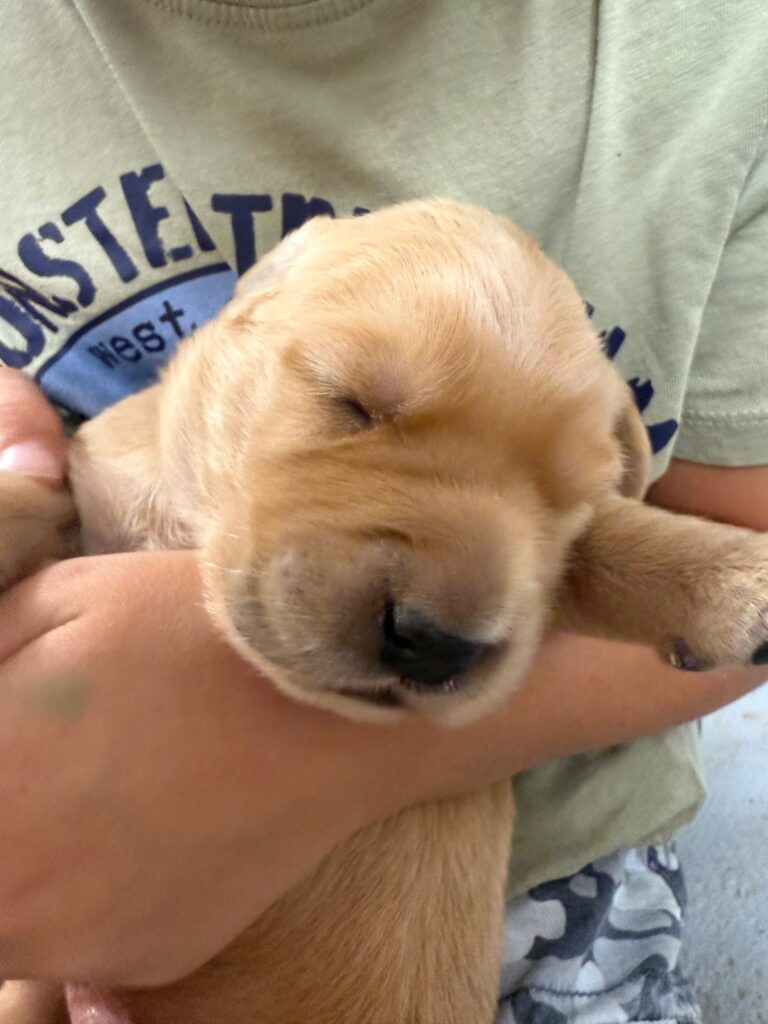
We perform genetic health testing on every puppy shortly after birth, but we also focus heavily on early socialization. By exposing our ESA Golden Retriever puppies to various sights, sounds, and gentle handling from day one, we help "set" their nervous systems to a default state of calm. When you bring home one of our calm temperament Golden Retrievers, you’re getting a dog that has been intentionally prepared for a life of service and companionship.

Where Our Goldens Make an Impact
It’s one thing to talk about science, but it’s another to see it in action. Our dogs are currently making a difference across the Pacific Northwest in several vital roles:
Hospitals & Hospices: Providing a much-needed oxytocin boost to patients and staff, helping to lower stress levels in clinical settings.
Schools & Literacy Programs: Acting as "reading buddies" who offer a non-judgmental, calming presence for children who struggle with confidence.
Special Needs Households: Helping individuals with autism or sensory processing disorders find a steady, biological anchor during overwhelming moments.
Starting Your Adventure
Choosing a dog for therapy or emotional support is a big decision, but it’s one of the most rewarding journeys you’ll ever take. Whether you are looking for a professional therapy partner or a gentle soul to complete your family, the oxytocin connection is real, and it’s waiting for you.
As you begin this adventure, remember that the bond you're building is supported by thousands of years of evolution and a whole lot of love. If you’re ready to meet your future partner in healing, learn more about our mission and our available puppies.

References
Nagasawa, M., Mitsui, S., En, S., et al. (2015). Oxytocin-gaze positive loop and the coevolution of human-dog bonds. Science, 348(6232), 333-336.
MacLean, E. L., & Hare, B. (2015). Dogs hijack the human bonding pathway. Evolutionary Anthropology.
Beetz, A., Uvnäs-Moberg, K., Julius, H., & Kotrschal, K. (2012). Psychosocial and psychophysiological effects of human-animal interactions: The role of oxytocin. Frontiers in Psychology.